
Episode 34
Titus Gebel: Breaking the Political Cycle
Published
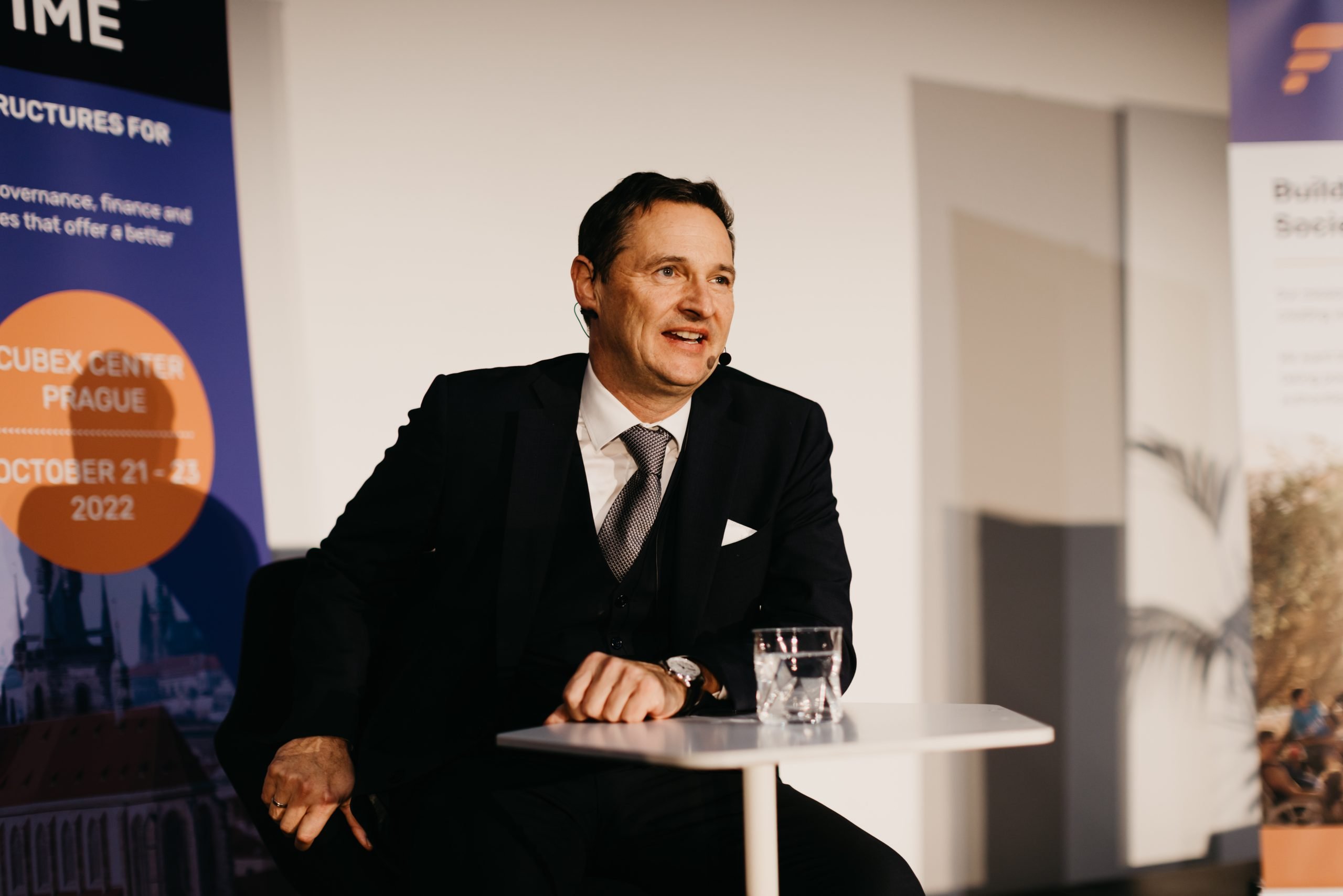
"It's inevitable that if you have a legislative body, then over time the number of laws will increase, the taxes will increase, indebtedness will increase and the number of people who are not productive will increase. That is in my view, absolutely inevitable. So you have to change the system... And I have made a p..."
It's another of my discussions from Montenegro again this week on the podcast and this time it’s part one of two conversations I had with none other than the Founder and President of the Free Cities Foundation himself, Titus Gebel.
Now, since most of you will know who Titus is I will keep this intro brief. Obviously, he has done many interviews before so I tried my best to keep this conversation away from the usual Free Private Cities talking points and delve a little deeper into the history of different city-state models and their modern-day incarnations. I also got to probe a little into Titus’s own history and motivations as well as some of his predictions for the future of the idea that government should be a service.
We recorded together on two separate occasions and part two of this conversation will be a deep dive into medieval city-states which is a discussion I’ve been pining to have for many months now, so look out for that one over the next few weeks.
Enjoy the conversation.
Audio version
Read transcript
Use ¶ beside a passage to link directly to it.
Transcript
Timothy Allen:
Well, I think you’ve done a lot of interviews. Just looking on our YouTube channel, there are hundreds of interviews with you, and I would imagine that when most people interview you, they come up with roughly the same questions. Is that right?
Titus Gebel:
That’s true, and it’s surprising how rarely new questions pop up.
I remember the last really new question was about half a year ago. Somebody asked me, “Who will build the cemeteries in the Free Private City?” That was a new question. That was a first-timer.
On the other hand, I cannot complain. It’s natural that if you hear about the Free Private Cities concept for the first time, some questions will pop up immediately.
It’s things like, “Is it for everyone, or do you have to be rich to be there?” and, “How do you protect against the host nation taking over?” and, “What about social security?”
Those are basically the main questions.
I have developed answers to them, because it is natural. Then the next level is more tricky questions, which people who have really thought themselves into the model have.
For example, what about contract changes? That is a very legitimate question. How do you deal with people who are born in the city? What about people coming later? Do they have a different contract? How do you manage that?
These are all legitimate second-level questions.
Then you have a lot of people who just do not fully get the model. They say, “It’s very important who owns the company, so if I’m the good guy, it’s okay, but if another one takes over, it’s bad.”
But that is not the model, because it’s a contract. It doesn’t play a role who owns the operating company. That is hard to understand for many people.
The other thing is democracy. If I say, “What I do is provide relatively limited services, and for everything else you are on your own,” why do you need a parliament if you can make decisions for yourself?
That is also very hard to understand for people who have lived their whole life in traditional legacy systems.
So this is more or less the universe of questions that normally pop up, and rightly so.
I am glad that I am at least invited to talk about it, because often, especially with mainstream journalists, they say, “He is against social security and against democracy,” without giving any explanation. They just try to put us in a bad light.
So I am happy for everyone who asks me why this model is working in this way and not another, because there is a reason for everything.
With the democracy thing, if you can decide for yourself, Timothy, then why do you need a parliament? You don’t. Self-determination is our model, not political participation.
This is, of course, different if the ruler of a city can make all kinds of decisions. Then you would definitely have to come back to a participation model. But this is something where I maybe haven’t yet found the ideal way to put it so that all people can understand. But I am also training.
Timothy Allen:
Maybe one good way to approach it might be to talk about examples from the past.
From my experience, I’m relatively new to these concepts, but I’ve sat down with almost 40 people now and had conversations around this topic. One of the things I’ve drawn from that is that without a working example, it’s all theory and hypothetical, which is not good.
We have examples like Próspera. On the spectrum of the model, we have an example. But really, I think maybe we have to look to the past to find working examples. Is that right?
It’s something I haven’t spoken a lot about on this podcast, and I’d quite like to find people who know about medieval cities, for example, that a lot of people refer to.
So maybe we could talk a little bit about that.
Titus Gebel:
Yes. I’ve studied all those models to find precedents, because I’m not the top-down guy who says, “I have an idea and now the whole world has to follow it.”
I was rather looking for what was working in the past and how we can transform this into today’s world.
Rightly, you say we need examples. That is also the reason why I am not only active in promoting the idea, but I also want to make it a reality.
I am a lawyer by education, later I got an MBA, but 20 years ago I stopped being a lawyer and became an entrepreneur in the mining sector. I built up a relatively successful company out of nothing with a partner, which is now producing 10,000 barrels of oil per day and had a gold mine and tungsten mine.
So I think my capacity for creating companies, I have to use that for this purpose now. That is what I will do for the rest of my life.
If you haven’t heard, I was involved in Próspera early on. I helped them design their legal structure. In the last two years, together with my partners, I negotiated with an African government to get a similar autonomy. Unfortunately, there was a change in government, and the new leader didn’t like the idea. That is what can happen, and that will happen again.
Coming back to working examples, we will create new working examples, so it is much easier to point to people and say, “This is how it looks,” instead of explaining a theoretical concept.
But if you go back in time, before we come to the medieval cities, I would not go back that far. Let’s go back to the 1960s, with the first special economic zones.
One of the blueprints was Shannon Airport in Ireland. Planes coming from continental Europe had to stop over there to fuel up before the big journey over the Atlantic. Then at the end of the 1950s, planes became technically capable of flying non-stop from Paris directly to New York, without a stopover at Shannon Airport.
Several thousand people worked there, so the government in Ireland said, “What do we do? They’re all losing their jobs.”
They came to the idea of creating something that would make incentives for companies to come there, despite the airport no longer being necessary. They basically decided that in Shannon there would be different rules, more favourable to companies: lower taxes, less regulation, no import-export duties, and so on.
That worked.
In the 1960s, there were maybe five zones. Can you imagine how many zones we have today that are called special economic zones?
Timothy Allen:
It would be a shot in the dark. I don’t know. Thirty?
Titus Gebel:
Five thousand. Over 5,000 in around 145 countries.
So this is definitely a successful model. Otherwise it would not have been copied so often.
A special economic zone is not so different from my Free Private City concept, because it says there are some areas where there will be different rules. Mostly there is a private administrative company running the special economic zone.
Most of them are just for businesses, not for residents. Often residents are even forbidden.
But here is the thing. Every single special economic zone in the world is a confession and a commitment.
The confession of the state is: obviously, our rules are not the best, otherwise there would be no need for that zone.
The commitment is: we guarantee that in this zone, you can operate according to these rules. Because if we change those rules, which can happen in some countries, then companies will never come again. They need long-term stability.
Most of these zones have guarantees of 50 years or something like that.
This is a good example of how a model can work that says, “I have different ideas. I propose to you, state, that in a certain defined area, we try out a different set of rules.”
That has already been done. It’s called a special economic zone.
What we do now is extend that autonomy a bit, make it open to residents, and also have our own dispute resolution system.
This is new, but it is not totally new, because you have the Dubai International Financial Centre, which had exactly that problem.
Dubai’s success story was not so easy in the beginning. Eventually they found they had many special economic zones and a lot of manufacturing there, but they wanted to attract the finance world, and the finance companies were not coming.
Why were they not coming? This was back in the 1980s or 1990s. Well, because they didn’t like Sharia law. You could be put in prison if you owed something to somebody.
So the Sheikh asked, “Let’s just import another law that is more popular with finance companies. What is that?”
The advisers told him, “If you look at the big financial hubs like London, New York, Singapore, and Hong Kong, they are all running on common law, actually British common law at the root.”
He said, “Then let’s make a common law system.”
The other thing was, “People do not trust local courts in the Arabian world.” That is just a given, even if it is not justified.
Then he said, “Well, let’s import judges from London.”
That is actually what happened. They came up with their own common law system, which in the meantime was even extended to family law, because high-potential financial managers also do not want to be subject to Sharia law when it comes to marriage or inheritance.
They imported judges from Singapore, London, and other common law countries. They have their own court system.
That is another working example.
The success is tremendous. They started with 10 or 30 companies, and now they have more than 1,000 companies registered in the DIFC, which is a small area of Dubai, about a square mile or less. I think it is responsible for about 10 percent of Dubai’s GDP.
So you can say there is a working example. They have their own regulatory capacities, a different set of rules which is totally different from the rest of Dubai, and their own court system.
What is missing for a Free Private City is a contract with people, and security with its own capacities as well.
Then you come to Honduras, where you have those. Honduras is modelled after Hong Kong, which is officially called a special administrative region. That means it belongs to a country, in this case China, which is responsible for foreign policy and defence, but everything else is handled by the special administrative region. They have their own parliament, their own police, their own flag, their own currency, and their own courts.
Put aside the problems Hong Kong has with China. This is one of the issues that people come up with about Free Private Cities and the host nation, and rightly so, but that is not the topic now.
The model is a system within a system, and that exists. It is called a special administrative region, like Hong Kong or Macau.
Then you have very extended special economic zones like the Dubai International Financial Centre, which is rather a special administrative region than a special economic zone.
And you have new models like the zones in Honduras, where some people say it is a special economic zone. But I would clearly say it is much more, because they basically have a blank sheet in making rules.
Okay, they need approval by a government committee, but once the approval is there, this is a different system. The reason is that the Honduran government wanted to create a Hong Kong-type environment in Honduras. So it is no wonder they are as autonomous in many areas as Hong Kong or Macau are.
That hopefully answers the question about working examples.
Of course, we want to get one step further with a contract-governed service: government as a service. The government is giving you a service contract. You are party to this contract. You are protected by the contract.
Even there, you can point to a working example, which is ZEDE Morazán and ZEDE Próspera. Próspera has an agreement of coexistence with its residents, and they are protected. They have a Bill of Rights in that agreement.
So it is there. This is also very helpful when negotiating with governments.
I remember negotiating with a government in Central America about a year and a half ago. You could see the relief in their faces when I said, “A similar law already exists in Honduras, and there is another one in Azerbaijan that gives a special economic zone large autonomy.”
You could formally see the relief in their faces, because as a politician, coming up with something completely new is a hard sell. If you say it is already there, that helps.
I think this is also very encouraging, because I see a trend starting in the 1960s with Shannon. Special economic zones are becoming not only more and more numerous, but also more and more autonomous from the host nation.
I see a trend here, and this is a strong momentum. There is a reason why not only me, the Free Cities Foundation, and my company Tipolis are here. There are, I would say, two handfuls of players worldwide who really want to make something like this happen. That shows me that the time is right now.
Timothy Allen:
Something just occurred to me. On your stages of autonomy, quite near the end was security.
That does seem like a contentious one, because it is potentially fighting the monopoly on violence that a state might have. I could see that being a very strong hurdle. It’s almost one of the final stages of autonomy.
Titus Gebel:
Yes.
The reason this was put in the Honduran ZEDE law was exactly that. They wanted to avoid the police and prosecution being used for economic purposes.
You have seen this in former Soviet Union countries. They make all kinds of claims against you, like violations of environmental law, unless you give them 10 percent of the company. Then they drop the claim.
I think there was a case with a water monopoly in Roatán, where the water monopolist wanted to stop Próspera providing water to a neighbouring community. So they sent the police in, but they were stopped at the border because, as a ZEDE, they said, “You have no competency here.”
This is a typical example of why this is necessary. In many countries, the police are not used as they should be, to protect people. They are used as a method to get economic purposes enforced against other people.
So you are right, this is difficult, but I think it is also necessary.
What we are doing is negotiating with governments and saying, “This is what we need. We need some internal autonomy, and these are the areas.”
There are compromises possible. For example, if there is a capital crime like murder or rape or a big robbery, then we make a joint commission with your police and investigators.
The other thing that is, at the moment, not easy to overcome is criminal law. Most countries disagree that we have a different criminal law. So the compromise is: we take your criminal law, but we apply it with our institutions.
That is not so difficult, because there are already special economic zones that have private security and all that.
This is limited experience, because it is a new market and a new system. But I have negotiated with, I would say, 10 governments in the last five years. I can say that getting rid of criminal law and replacing it with your own system is basically not doable. But getting your own security and not having the police of the host nation competent for you, that is negotiable.
Timothy Allen:
That’s real-world experience.
This brings me on to the most commonly brought up question whenever I speak to anyone about these jurisdictions, which is, what happens when the government just comes in and says, “We want it”? How do you mitigate that, if at all?
Titus Gebel:
You have to mitigate it. From the beginning, that is the biggest problem. If you are too successful, you have a problem.
On the other hand, this is not new. You have special economic zones that are successful. You have small countries like Monaco that are extremely successful, or Liechtenstein. Why are they not invaded by France, Switzerland, or Austria?
The reason is that it is a trade-off.
Monaco is not invaded by France because they nearly were in the 1960s. Here is a very instructive example.
Monaco has no income tax. In the 1960s, rich French millionaires and businesspeople were all making their money in France and then moving to Monaco. So they didn’t pay taxes on their wealth to France any longer. Monaco had no income tax, and that made the French angry.
They threatened to block Monaco completely. They actually blocked it for a couple of weeks so nobody could go in and out. Monaco is totally surrounded by France. It just has an open border to the sea.
Eventually, this was solved by an agreement.
It is instructive because Monaco also had friends, like in the American government. After all, the prince was married to Grace Kelly, who was a famous American actress. They had friends in governments: Italy, the Vatican, the US.
There is even a movie about it. I think it was true that the American foreign minister said to the French, “Do you want to bomb Monaco?” Of course not, because it is a reputational issue.
That eventually led to the parties coming together at the negotiation table.
A Monégasque diplomat told me that what helped them was that they had really kept up all the protocols and treaties of the past, sometimes going back hundreds and hundreds of years, which they had with the French government. They pointed to those treaties.
Eventually, there was a compromise reached in, I think, 1963. It said that from now on, people moving from France to Monaco have to pay taxes to France. But not anybody else. If you or I move to Monaco, we have no problem unless we have French nationality. People who had moved from France to Monaco before that date were grandfathered in. Their rights remained.
This is still valid today.
So there was a compromise reached. Now Monaco pays for French policemen if they have a big football game or the Grand Prix. They don’t have enough police to cover the event, so they hire French police and pay for it. They pay for infrastructure towards Nice airport and all that.
Monaco has a use for France because it attracts a lot of people who do not just stay in Monaco, but also spend money outside. The three French communities surrounding Monaco are very affluent, all three of them, for a reason.
So there is a clever aspect to it. On the other hand, the painful aspect is mitigated by the contract. The contract says they have to have the same level of tax for VAT, cigarettes, liquor, and petrol. Because otherwise, if you had no petrol tax in Monaco and tax in France, then all the petrol stations near Monaco, within 50 kilometres, would go out of business. That is a typical special economic zone problem, and they mitigated that.
The pain side for the French is covered by this contract, but there is still a bonus side for the French, which is the reputation of Monaco attracting people to the whole Côte d’Azur.
That is the main answer to your question. You have to create a win-win situation, or at least mitigate the pain for the country.
How do we do this, other than with what I just said? First and foremost, treaties. Make it very painful for the country to violate what they have signed.
We are seeing that in real life in Honduras. There was a new government elected that said, “This is all illegal. Yes, we changed the constitution. Yes, we made a ZEDE law, but this is all illegal from day one,” which is obviously not very convincing. They will very probably lose their case.
Governments then will probably kick the can down the road, and the next government will say, “Maybe we should come back to the negotiation table.”
My answer, which I wrote in my book, is that you need several layers of protection.
First and foremost are treaties with investor protection clauses. The company that is running the show should be from a country that has a bilateral investor protection agreement with the host nation. That was the case in Honduras, on purpose, and it works now.
So you make it very painful to violate the treaties they have signed.
The other aspect comes into place after five to ten years. There will be a lot of jobs in this entity, in the Free Private City. A lot of companies from the host nation will do business in the Free Private City. A lot of families will depend on that income, and these are all voters, or they have relatives who are voters.
This is another incentive for the host nation not to destroy it.
The third aspect is that we can announce that our people are highly mobile, high-potential people from all over the world. The majority will probably be from the host nation, but many good people will be from elsewhere. If you invade the city, we will just leave.
It is no longer a successful model. That is what will happen to Hong Kong. If China continues to basically mob Hong Kong and make it a normal Chinese city, then it will be a normal Chinese city and will not have all the advantages Hong Kong had.
This is another thing where we can clearly say it is not in the country’s interest to do that. There will always be political opposition in the country who will say how stupid it is to militarily invade a Free Private City if the city is making payments to the country, and so many people are profiting from it.
I think this is not total security, but it will help. It is interesting to see what the outcome of the Honduran model will be.
Próspera has made a claim of 10 billion dollars against Honduras, which is 50 years of lost profits and what they have invested so far.
My gut feeling is that, at the end of the day, there will be an agreement, maybe not with this government, but with the next one.
Timothy Allen:
Talking to Hondurans about this, a lot of them are of the opinion that originally the pushback on the ZEDEs was a political move at election time. Now they’re in power and things are moving along, it’s chilling out a little bit, which makes total sense to me. Arguably, that’s the way it will play out.
Can I ask a question about Monaco? What is the history of Monaco? How has Monaco ended up being what it is now?
Titus Gebel:
It was originally hijacked. It goes way back in history, to around 1200.
There was a religious conflict, like so many in the past of Europe, between people who were supporters of the Pope and enemies of the Pope.
The Grimaldi family, originally from Genoa in Italy, were supporters of the Pope. The enemies of the Pope were holding the fortress of what is today Monaco.
Under disguise as a monk, one of the Grimaldi knights went in, opened the doors, and then they took over. They have kept ruling that rock since 1291 or so. So, about 700 years.
They came under pressure several times, were invaded and not in power, but they always got back in power after the wars ended.
They were also bigger in the past. The surrounding French communities, including Menton, once belonged to Monaco. It was much bigger than today. Today it is only two square kilometres, the second smallest country in the world. But until 1860, it was much bigger, about 20 times that size.
Then there was a referendum where parts of what had been Italy, or Savoy, were going to France. Most of Monaco’s surrounding areas voted to become part of France.
One of the reasons was that France had no income tax at that time, and Monaco had income tax.
Timothy Allen:
That’s incredible.
Titus Gebel:
Maybe in the long term it was a bad deal.
It took some decades until the Prince of Monaco realised that 90 percent of his income was coming from the casino and other things. He said, “The income tax only accounts for 5 percent. Forget about it.”
From around the 1890s, there was no more income tax in Monaco, and that is still the case today.
The casino is no longer really relevant today. Monaco makes about 50 percent of its income from VAT, and it has to use the high French rate, around 20 percent. Then it has real estate transaction taxes. Given the high valuation of real estate in Monaco, that also accounts for a lot.
They still own the Société des Bains de Mer, the casino and hotels, but to my knowledge it only accounts for 5 to 10 percent of income today. So the casino doesn’t really play a big role any longer. Real estate transactions and VAT do.
Timothy Allen:
Does Monaco hark back to the time of medieval city-states? What was the landscape like?
Titus Gebel:
No, it was a real principality. It wasn’t a city-state.
We could have an extra podcast on medieval city-states, because there is a lot to talk about.
Medieval city-states basically came into existence when cities themselves came into existence in Germany and Italy.
You had some from Roman times, but not many, especially in Central Europe. Then, in the Middle Ages, the city as such became something.
Over the years, people found out, first in old cities like Cologne, which was a city back in Roman times, that they were part of a bishopric. Like all cities, they were ruled by a bishop, who was not only a religious leader but also a factual ruler, a prince, a duke, or whatever.
The Holy Roman Empire of the German Nation consisted of what is today Germany and Italy, and had all kinds of monarchs, hundreds and thousands of different principalities.
In the cities, people found out relatively soon that the monarch didn’t care about them. They were sitting together so densely, it was very creative, and they were successful. They said, “This monarch, be it a bishop or a prince, is sitting in his castle and doesn’t know what is going on here. He is just taking taxes, but he doesn’t care. We need extra rules because the city works differently from the rest of the country. It is much denser. We want to trade with other cities, but we can’t because of duties and all kinds of regulation.”
For example, whether you were allowed to have a certain profession. It was not like today where you just choose your profession. Sometimes you could only inherit what your father did, or whatever the monarch came up with as to who was allowed to do what.
I remember reading that the first attempts in Cologne were around 1100. They said, “We want to get rid of our bishop. We want to be independent and only under the emperor.”
The emperor was far away and had no standing army or standing administration, so it was more formal. They would still be under the empire, but within that empire relatively autonomous.
It took around 100 years for Cologne to eventually get rid of the bishop. They did this by militarily beating him with the support of a neighbouring prince. That is how things went at that time.
That brought them, and other cities in a similar way, the autonomy they were desiring. They could make their own rules and establish a city council.
Other cities followed. It was basically the businesspeople, the honourable people, making all the decisions. Over time, the number of voters increased.
Then you had the extremely successful upper Italian cities. It was a little bit like the ancient Greek polis. You could really see what goes wrong with democracy over time.
In the Italian city-states, it was a powerful family that basically took over, like Genoa, Pisa, or Florence. In Florence it was the Medici family, which was the power family.
The people from Venice said, “We don’t want that. We don’t want one family to rule the show.” So they came up with a very complicated voting system, which made it impossible to buy votes by making promises, because you didn’t know how you were voting. A group of electors was elected, they elected others, who elected others, who eventually named the government.
It was unforeseeable who would be in government. That meant no bribing of votes, no populistic messages to get voted in, no welfare state promises, and things like that.
It was a successful model. Venice was a city that originally started as part of the East Roman, Byzantine Empire, and eventually became factually independent. It lasted for 1,100 years without a single government being overthrown. That is huge.
This city had the biggest naval fleet in the world in the 1600s. With the right system, astonishing things are possible.
Timothy Allen:
What was it about Venice that meant they went down that route? Why weren’t they just a family deciding to take control and run the place?
Titus Gebel:
Because it was not possible under the system they had established.
Timothy Allen:
I’m wondering why they established that system.
Titus Gebel:
Because they looked at the other Italian cities and saw what was happening.
Probably in the beginning they had the same system as the German cities and other Italian cities, where the businesspeople elected a council. Over time, the number of voters grew. Other social groups were entitled to vote. Then powerful networks basically had power in their hands and distributed it among themselves.
At one point in time, they observed what was happening in Genoa, Pisa, and Florence, and said, “We don’t want that.” Then they came up with this complicated system.
You maybe know from movies that they had masks on, so people did not even know who the others were. They said, “We have to guarantee that everybody will eventually become a little bit like Switzerland, that everybody will sooner or later become part of government, but we do not know who in advance.”
Out of the top of my head, it was super complicated. The population of Venice elected 25 election men, or something like that. Those 25 nominated another 25 people, who then nominated others. For you as an individual political or rich person, you could not really influence the process so that you knew who would end up in government.
That worked very successfully, and that is probably the reason why there was always a majority in Venice not to change the system. They saw what happened in other places, and they saw how successful they were themselves.
Timothy Allen:
Two questions then. First, how long was the transition into that system from the other one? And my second question is, what finally caused the end of it?
Titus Gebel:
To the first question, I don’t know frankly. I assume when they started around the year 690, they were probably just a tribe, people fleeing the downfall of the Western Roman Empire onto the lagoon because it could be defended more easily.
Probably there was just a leader, an elected chief or whatever. It took several hundred years until they really developed into what they later successfully became.
If I remember correctly, I have read that they wanted not to make the same mistake as the other Italian cities. That must have happened around 1400 or 1500.
Venice came to an end in 1797 when Napoleon invaded the city.
That is a good question, what brought it to an end. After Napoleon was gone in 1815, you could have expected that maybe they would rise again. But no.
The people were probably a little bit like the West today: too long too successful, too wealthy.
You know the saying that hard times create strong people, strong people create good times, good times create weak people, and weak people create bad times. I think that is what happened in Venice.
Despite being so successful for such a long period of time, they did not have enough energy and power to re-establish Venice as an independent entity when Napoleon was gone. First they became part of the Austro-Hungarian Empire, and then eventually Italy.
It is only now that people want to make this autonomous again. There is a movement in Venetia to make it at least a more independent region within Italy.
Also, we are now sitting here in Montenegro, and not far from here is Dubrovnik, which was called Ragusa. It was known as the little sister of Venice. They copied Venice. On a much smaller scale, they were very successful.
Their motto was, “We are not giving away our freedom for all the gold in the world.” They had a really strong self-determination and liberty focus, and they kept it up until they also were militarily beaten.
People think a city is so small and defenceless. No, not at all. Few people know that Singapore has submarines and more tanks than the German army. It is just not true.
With economic power comes military power, and especially the awareness that people have that they do not want to spend their own people’s lives in wars. They always hired soldiers of fortune.
Timothy Allen:
That’s interesting. You’re alluding to the cyclical nature of top-down, bottom-up governance, or freedom and authoritarianism.
Is it an eternal struggle? Is this something that never gets fixed?
Titus Gebel:
Becoming decadent if you are successful over generations is probably not stoppable.
But what we can do, and that is my idea, is to establish not only one Venice, but hundreds. Then, if some of them fail, the model will still survive.
Timothy Allen:
Let’s talk about that then.
In your mind’s eye, what I find impressive about what you’re doing, and I was acknowledging this last night when we were talking, is that you’re thinking long-term in the future.
A lot of what you’re doing now is, “We need to do this now.” And I’m like, “Why?” And you say, “Because in nine years’ time there’s going to be an election here.”
That, for me, is an unusual way of thinking. I’m fascinated by the mind of someone who is thinking that far into the future.
When you go to this place in the future where you find a myriad of city-states or independent jurisdictions, describe that landscape for me. What does it look like? What’s the best outcome you see, and what’s the timeline?
Titus Gebel:
Timeline is a difficult question. My experience in life is that it always takes longer and is more difficult than you think, and it is probably the same here.
Nevertheless, I was surprised that we could start so early in Honduras, but that was because the Honduran government enabled it. They wanted to create Hong Kongs, not private cities.
Then the people running the show at Próspera stumbled upon me and said, “Can we make Próspera a little bit more Free Private City-like?” It was a top-down Hong Kong approach, where a governor called technical secretary was making all the decisions. We did it. Próspera is now a charter-slash-contractual city, I suppose.
What is the ideal world in the future? Let me describe it this way.
If you were a young person born in a Free Private City, you would be under the contract of your parents. When you are 18, which would probably be the age that defines you as an adult, although it could be any other age, the city would give you a year to decide if you also want to become a contractual party on your own.
You could travel the world, look at other places, and probably what happens is you say, “Well, there is a more humanitarian basic income society, with a lot of young girls and free love, at least that’s what people say.”
As a young person, you might move into that for a time, being more idealistic and seeing a lot of artists, music, and culture.
Then, after some years, you probably want to start a family and become more economically successful. You move back to a Free Private City and say, “I have everything here. I can start a business within five minutes. I can put my money outside and it will not be taxed away. They will not change the rules, so I can plan for my pension. I can start a family here knowing that I can send my children out at midnight without fear.”
So that is probably a good place for me in my 30s, 40s, and 50s.
Then maybe, when you are getting old, you say, “My father and my mother are from Denmark, and I want to experience all the original tradition of my Danish culture.” Maybe you move to a more Alabama-type society, where it is a little bit calmer, not so much hustle and business like in a Free Private City. More of a resort-type environment.
If you have a cultural or ethnic background from some area, maybe you want to go back to that.
We don’t know if this will still be the case in 300 years, but I think you can live a portfolio life if you want. Or you can stay in one city, where maybe you have areas in the city catering to those needs.
I think it is very fascinating. A good model for young people is what I have heard about the Amish people in the US. This is an intentional religious community. They say to the young people, “Now you should learn about the outside world and travel around for two years. Then you decide if you want to come back to us or go somewhere else.”
I heard they lose about 50 percent, but it’s a good model.
This is my vision of the future, that all kinds of ideas will compete.
What I have offered in my book, my concept, and my white paper is the Free Private City. This is just a start. You go from there in all kinds of directions.
Joe Quirk, president of the Seasteading Institute, rightly said that in 50 years’ time, the most successful societies will probably not be something that is in discussion today. There is no ideology existing yet that would describe them.
Maybe this is the case. I think the learning curve will be much steeper. It took 70 years to find out that the Soviet Union does not work. But if you have hundreds of competing societies, you will find out much quicker and you can copy much quicker what is working and what is not working.
People would expect that from you. They would point their finger to the neighbours and say, “They do it like this, they pay less, they have a better quality of administration, so why don’t we do that?”
Maybe the majority of people will want to remain in their nation states. But even there, they would say, “These Free Private City guys have a contract with the operator. We want a contract too from our government.”
These are the effects that I see coming.
Of course, it depends on us being successful. That is why I am so keen to start now, even if only the next generation will really see this world unfolding.
Timothy Allen:
One of the very important components of that model is the ability to travel.
We’ve all seen an incredibly dangerous precedent set over the pandemic, for example. What is your general feeling about that? Even if your individual private cities are welcoming to you, if you can’t fly over someone’s state, you can’t get there.
Titus Gebel:
That is why I advise and recommend that Free Private Cities have access to the open sea, which has always been, for thousands of years, the door to the world.
Even Monaco has a small space going to the high seas, which is not under the sovereignty of France. It was not necessary to use that in the last 50 years, but if you have to, you are happy that you have a way out.
Another method of dealing with that problem, whether it is a pandemic or whatever they come up with, like climate as a reason why you are no longer allowed to fly, is that Free Private Cities and similar models associate with each other in some areas.
One area would be travel and mutual visiting, a kind of new Hanseatic League. That is one of the ideas already in discussion.
Timothy Allen:
You’d better define that. What is the Hanseatic League? Give me a 101.
Titus Gebel:
The Hanseatic League was a kind of predecessor of Free Private Cities.
These cities were still part of empires, mostly the Holy Roman Empire, but also Denmark, Norway, even England or Russia.
These cities allied together in what was later known as the Hanseatic League. The main purpose in the beginning was that businesspeople could travel freely from one city to another and be protected by the same rules.
They were so successful that they had their own warehouses even in London, which were under the Hanseatic League regime. They were strangely not a sovereign entity, not a decentralised nation, but on the other hand they could even wage war against one of the main powers of that time, Denmark.
So it was a kind of association of free cities.
Interestingly, there was a main city, Lübeck. Lübeck was important, and they were copying Lübeck rules. But it was completely voluntary. There was no telling other cities what to do. Cities could decide if they wanted to join the Hanseatic League, and they could decide if they took over Lübeck or Magdeburg law, or created their own law.
They only had to respect that if people from other Hanseatic cities were coming, they were treated well and had legal protection.
It was an association. In the future, where I think cities will become more important than nation states, we will probably see a revival of something like the Hanseatic League.
Timothy Allen:
Personally, I live on a former farm, right in the middle of nowhere. How do I fit into the Free Private Cities model?
It seems quite city-centric. I’ll be honest, I’m probably not ever going to want to live in a city again. I lived in London for seven years, but I’m over that. Are we talking about jurisdictions as well? Are there going to be places that are not cities?
Titus Gebel:
I think it is absolutely not necessary to be in a city. At the end, it is a jurisdiction.
Few people know that everybody talks about the free and imperial cities in the Holy Roman Empire, but there were also free imperial villages. These were really villages directly under the emperor, with no prince, no ruler, no monarch.
This is possible, and I don’t see any reason why this should not be the case.
The city is just practical. You can more easily set up administration, hospitals, and things, so that you can really be on your own. Whereas with a village, you are very often dependent on infrastructure in the surrounding area, which, if it has a different jurisdiction, they will probably capitalise on.
Like they do with Indian reservations. On paper they are sovereign nations, but they say, “Okay, if you want money from the federal government, you follow all rules.” That is a problem with villages and farms being independent jurisdictions.
Timothy Allen:
Security would be the thing. What’s easy in a city is to put a wall around it. How would that be dealt with in a situation with a much larger border?
Titus Gebel:
In today’s world, one of the things that will come to us if we have a different tax and customs system is that the host nation will ask you for a wall or fence, to avoid smuggling. I see this day coming.
For security reasons, I would make it dependent on the environment where you are. If you have a Free City in Switzerland, it is probably not necessary to build a wall.
But what you can do today is have drones or cheap cameras all around, or thermal cameras that detect temperature. Then you only need two or three people surveying and patrolling. You can have relatively cheap security for large areas.
Timothy Allen:
Can I ask you some more personal questions about you specifically? Purely out of my own interest. Have you got a family?
Titus Gebel:
Yes. I have two sons.
Timothy Allen:
What are they into? Are they into this idea?
Titus Gebel:
They are 29 and 19, and they are on board.
Timothy Allen:
Are they working in that kind of arena?
Titus Gebel:
Not yet. My older son has a security company in Germany, and I can imagine he can deploy that knowledge in Free Cities once we have them.
My younger son is still studying. He is in the UK at the moment, but he is running around in Free Private Cities T-shirts, so I assume he is also on board.
Timothy Allen:
What about your actual motivation? You did all right. You made a few companies. So what’s motivating you?
Titus Gebel:
When I sold my shares in the resources company that I founded, which enabled me to move to Monaco, I was asked why I do this. I could play golf for the rest of my life or whatever.
I said, no. In a way, I am a political person and always was. I think we have a kind of role to fulfil.
Of course, I could start another company, and I am still somehow connected with the resource industry. But I think if you have identified something that is wrong and you have a solution, it is your obligation to tell your fellow citizens, “Here is another proposal.”
In my case, it was 30 years of observing the political field. At one point, I was friends with federal ministers of my classical liberal party in Germany. I watched that and said, “This system is not going to end well. It is not working. It is not reformable. Eventually it will collapse.”
Then I thought, then they will ask for Napoleon again, a strong man. Then you have dictatorship. Then eventually it will be overthrown, reasonable people will come in, and then the good people will come into power and want to redistribute everything. Then it will collapse again.
I said, okay, maybe we should do something.
Since I became more and more libertarian over the years, and I’m 55 now, I’ve served some time on the political fronts.
I thought, “We know the market is the best mechanism to distribute everything so that the needs of people are served. And ethically it is the best system, because it relies on voluntary decisions. Why don’t we transfer that system to the system of living together?”
Then I said, “Yes, that’s it.” Now I had to work it out.
It took me three years to write the book. I interviewed a lot of people and read a lot. The book was published in 2018, and I think the main messages will remain unchanged.
It is a good starting point. I don’t know what the future will bring, but this is my contribution to the development of society.
That is probably what I am good at: observing and formulating things. There are better businesspeople than me, who are 100 percent into their business. I am always interested in everything. You have to find what you are good at and deploy it.
For me, it gives me a lot of satisfaction.
When I started as a lawyer, I was asking myself, “What am I doing here?” I was working for people who came to a lawyer with things I would never go to a lawyer with. They were just not relevant. I was producing papers, then there was a court decision, and then it was thrown away. It was not really satisfactory.
Producing gold and oil was much better, because it is real. It is something tangible. That was more satisfying.
What I have done now gives me the satisfaction that if I die tomorrow, I have at least done something that others can profit from. That is a really good feeling.
I am good at that. I was always thinking in a very long-term way. I know a lot of people, especially in the libertarian sector, say, “It is only about your lifetime, and our kids don’t matter.” That is nothing for me.
I think we are all coming from somewhere and going somewhere. It is part of our humankind that we take care of the past and future generations, and think, “Is there maybe something we can do to improve what future generations will do?”
That is satisfying for me as a person. It is my subjective feeling.
Timothy Allen:
Do you think the Free Private Cities idea, the Free Cities idea, is of its time now?
What I mean is, as a result of the internet giving people ideas, libertarianism has a bad reputation for never really gaining traction, but you could easily argue we’ve only just entered the free market of ideas in the last 25 years.
Prior to that, libertarian ideas were spread by word of mouth, books, or whatever. Now we have this explosion of ideas. We were talking last night about Brazil, for example, and the massive libertarian population in Brazil.
Why is that? Because they heard about it.
Titus Gebel:
Yes. It is a natural development.
This all started around 1800, with the Industrial Revolution, Adam Smith, and the idea, “Why are people not just allowed to make contracts with each other?” That was totally unusual for thousands of years.
It doesn’t fit with our herd mentality. This is still a problem, and that is why libertarians have such a bad reputation. It is not what people are used to.
But more and more people are coming from this.
Or let’s put it another way. Our legacy systems are coming from the past.
Who was ruling in the Stone Age? It was probably the strongest warrior, who was the head of the tribe or chief. Then he added somebody to make it all make sense, and that was the priest. These two were running the show forever.
Eventually, people said, “We also want to have a say.” Then the princes elected the king. Then a bigger group elected the president. Now we have democracy, but we are still electing a king.
This is not happening in the rest of our lives. We decide for ourselves if we want sparkling or still water, if we want to make a holiday in Thailand or Mexico. That is our decision. We don’t need a decision-maker for us.
More and more people say, “You are now deciding I am not allowed to travel, I have to be vaccinated. I don’t want you to make this decision for me.”
Even if we are politically a tiny minority, I think our points are so strong that they will automatically pop up. Even if you consider yourself left-wing, you probably don’t want other people to decide for you.
If so, make a left-wing Free City. You don’t even have to call it a Free Private City. Make it a cooperative that owns the operating company. Not a problem, as long as it sticks to the contract. Otherwise, people will leave.
So I think the time has come, because it is obvious.
It is not that Titus Gebel has made a top-down idea of what is best for all. I have just transferred something you already know, a service contract, to the area called the market of living together.
It is actually just a transfer idea. It is not totally new. That gives me the conviction that this is doable, because it has been done in other areas of life. You make a service contract. If the service contract is not fulfilled, you sue that party, keep your money back, or there is a trial. We all know this.
Now I say government is just a service like any other. There are a lot of people who deny that, but I think they have no point.
Timothy Allen:
I’ve been having a lot of interesting conversations recently about the notion of online communities manifesting in real life, and this being a strong driver towards these kinds of communities. What’s your opinion on that?
Titus Gebel:
The internet definitely helps to find like-minded people all over the world.
After all, what is a Free Private City? It is based on the same ideas and values rather than on ethnic, religious, or other bases.
The whole world is open to it. You say, “Do you like those ideas? Then you are our guy. Please come.”
Internet communities can more easily prepare to make Free Private Cities happen in reality. One of the problems is that if you start from zero, and we have to, because we do not want to force people into that system, then you have an empty city. You need people coming there.
That is one of the big bottlenecks.
You can see it here in Luštica Bay. We are sitting in an extremely beautiful private development, a gated community. In the summertime there are a lot of people there, but outside that, not so many.
How do you make this a real city? It is not enough to have nice real estate. You need common values. That is where this comes into play.
Timothy Allen:
That’s interesting. I’ve never thought of it like that.
I don’t have a great fondness for places like this, funnily enough, for that exact reason. You’re finding that a lot in the centre of large cities now, which are just real estate bubbles with no soul.
Titus Gebel:
Exactly.
Timothy Allen:
So your antidote would be to found the city on an ideological commonality.
We’ve just come from Montelibero, which is not a Free Private City concept, but it is a community one. That was phenomenal. It was such an exciting experience being in a group of people who were all there with the non-aggression principle as one of their core tenets. They are all pretty much libertarians, and they are doing that.
You do see that is what is going to keep it together. That is the glue that is going to stick the community together in the end.
I’ve never thought of it that way before. That’s a good way of thinking about it.
So how do you stop terribly horrible ideological cities arising? Do they just get competed out of business?
Titus Gebel:
I can’t stop them.
If you are a voluntarist saying people should voluntarily associate under whatever ideas they want, then so be it.
The only thing is that I would say people should have the right to leave. But I am not going to bomb or invade those cities, as I am not going to bomb North Korea, Iran, or other fundamentalist, religious, or communist regimes.
I think we have to live with that. People have the right to make mistakes. They have the right to try out things.
At the end, Timothy, if we by force prevent a crazy-idea city from becoming reality, then people will at some point make it anyway. Maybe the next generation or whenever.
Someone once said every idea that is around us will sooner or later be tested. I think this is probably true.
The good thing about the Free Private City idea is that it is limited to certain areas. Ideally, there will be hundreds or thousands of Free Private Cities. If you have two or three dropouts, that is limited damage.
If you have a wrong system like the Soviet Union for the biggest country in the world, that has a huge impact. But if it is only a 10-square-kilometre city doing crazy things with volunteers, the damage is limited to the rest of the world and to the people themselves.
Timothy Allen:
So an essential part of the model is small scale?
Titus Gebel:
Yes. The problem is that if it gets too big, then it is probably no longer steerable.
A very interesting observation is that there are basically only 10 companies in the world that have a million people, and only one that has two million, which is Walmart.
This is not a planned development. Obviously, there is a certain size beyond which, even if you are a monopolist, it does not really work, because a lot of things are lost in the hierarchy and administration, and smaller players are more successful.
That will be found out over time. We have cities of 10 million people, and you can just separate them into different quarters and then manage them.
Timothy Allen:
What do you see as the future of the current states, the people in charge currently? Does that eventually devolve to nothing, or is it always going to be there to implement certain law?
Titus Gebel:
I think they have to become more service-oriented. Otherwise they will not survive.
That is exactly what, interestingly, the monarch of Liechtenstein, Prince Hans-Adam II, said. The state of the future has to become a service provider, not a demigod, or it will disappear.
That is exactly my view.
If we come with service-oriented models, and people are treated as customers and not as subjects, and we have more privacy and more freedom, then automatically people will come to us.
The state can build walls or punish people or make war against us, but this will only delay the process. It will not stop it.
Eventually, states will get pressure to become more customer-friendly than they are today, which is a good result.
Timothy Allen:
Of course.
I had a couple of interesting conversations in Lisbon about frontiers and the fact that we lack new frontiers now. The two possible ones being the sea and space.
Have you thought about space?
Titus Gebel:
Definitely. I think this is what is going to happen.
If people say, “I am so bored and I need to cater to a religion or anything because there is no sense in life,” I say, “You can work on better systems of living together. You can try to settle on the sea. We probably have so many planets now that it seems proven there are planets there, and statistically there will be livable planets. Now we have to find a way to get there and try new things.”
The whole universe is still open, like it was 500 years ago when people went over the oceans not knowing what was on the other side.
Now this is again the situation, maybe a little bit more problematic because the distances are so large. But I think this is the future of mankind, that it will settle the universe. I don’t know when this is going to happen, but for me there are new frontiers, many of them, out there.
Timothy Allen:
Do we see an evolution, though? Or do we just see state people leaving to find new frontiers, creating free societies, getting conquered, people leaving, creating another?
Historically, do we ever see the process of devolution happening and then new frontiers appearing?
Titus Gebel:
Venice is a good example. But it was conquered in the end.
Timothy Allen:
After a thousand years. I would take that deal.
Titus Gebel:
Yes.
When the Western Roman Empire was dissolving, that was basically the starting point for these cities and the Renaissance. There were dark times in between, but when it started back around 690, Venice was directly coming after that.
Now we have a big advantage compared to those times. I think what we are currently seeing is that Western civilisation is in crisis. It is going down. If I look at the skills people have compared with 100 or 50 years ago, you can have some doubts that this will continue.
So I think it is also necessary that new models pop up that can keep up that high standard of civilisation. These will be Free Cities, in my view, because they only need a certain amount of land and several thousand people. That is enough.
It is much easier than steering a 20-million-person country in a new direction.
I think this is something that is maybe accelerated through the downfall of Western society at the moment, and at the same time it is showing a way out of the crisis and the problems we have.
Again, it happened before when the Roman Empire went down, and what came out of it was basically the modern world. There is always a new beginning.
Timothy Allen:
A lot of people, when they talk about that, predict a chaotic crash of Western civilisation. I’m not sure I can see it transpiring like that.
I think, as individuals, we normally solve problems faster than those kinds of outcomes arise. That’s my opinion. What do you think?
Titus Gebel:
We have a much different situation from when the Roman Empire was going down, because it was basically the only country in this part of the world. People had heard about India and China, but they didn’t even know how to get there.
The others were the barbarians. There was the Persian Empire, which was the only adjacent bigger civilised nation. When the Roman Empire went down, there was nothing.
But now you have so many Western and industrialised countries. They are not all going down at the same time. Then you have the internet, and we are all connected to each other.
There are people like me who say, “Here’s a new idea, we are working on that, let’s start something.”
We have a big advantage compared to Roman times. We have many more political entities, which also create arbitrage options, and we are much better connected. We can learn more quickly and associate more quickly to form new entities.
So I think it would probably not be the big crash, but rather a long decay. During that decay period, more and more people will drop out and come to the new systems.
Timothy Allen:
The smoothest transition would be a slow draining of power from the old system.
Titus Gebel:
I think that is also the most realistic.
It is a good thing that we have more than 190 states. If we only had one world government, I would say that would be a disaster.
Timothy Allen:
Do you know much about what happened around the fall of the Roman Empire?
Titus Gebel:
Yes, I have read a lot of books about it. Still, Gibbon’s book from the 1700s by the English author Edward Gibbon is, I would say, the standard book for the downfall of the Roman Empire.
Timothy Allen:
Can you describe it?
Titus Gebel:
He was basically investigating what happened in the last hundred years.
You could really see a mechanism. Rome started as a successful empire, where it was a republic. Only the people who were paying taxes and willing to defend the country were voting.
Then it deteriorated into dictatorship, the big kings. People no longer wanted to do military service, so they hired others, like Germanic tribes, to do soldier work.
Then the emperors didn’t realise what Austrian economics has realised, that the more intervention they make, the more problems they create. Then they try to fix those problems, which creates a spiral.
At the end, you were not even allowed to leave the place where you were living. There were draconian punishments if you didn’t pay your taxes. There was really bread and circuses to keep the people happy.
It was all there, what we have today. It has been done before, it didn’t work, and it will not work this time.
It is a very interesting book. It is also a bit critical about Christianity, because when Christianity started, the first 400 years it was just a sect praying for the end of the world. They had zero incentive to improve their wellbeing now, because they were always waiting for the world to come to an end.
Gibbon says that because so many people were following this, and other crazy religions, this played a role. People at the end of the Roman Empire were letting themselves be buried and bathing in blood for 10 minutes. That was one of the cults at that time.
People, like today, were totally nihilistic, not knowing what to think or believe.
If you study the downfall of the Roman Empire, you can see a lot of parallels to today’s world.
Timothy Allen:
Why is that? Are we talking about the natural lifecycle of an empire? Why don’t good times create good people?
Titus Gebel:
I think it has to do with the state. That explains 80 percent, but not everything.
Even if you have a perfect system and everybody is wealthy, then people get crazy ideas.
But the other cycle that is inevitable is the political cycle.
Let’s start after a crisis. Reasonable people are elected into power. They have to fix things, and they come up with freedom of contract, rule of law, and all those things. Eventually society recovers.
Then the “good people,” in an ironic way, are voted into power and say, “Let’s distribute money to the people, to the needy, which means us and our cronies, and of course some real needy people.”
The problem is that the state has a monopoly of force. That means over time, more and more groups in society find out that they can go to the state and steal from others, because this is the easiest way to increase your standard of living.
Most of us, luckily, don’t do that. You don’t just grab into the neighbour’s pockets or go into a shop and take something without paying. Most of us feel bad about that, and that’s a good thing.
But there is an institution that can do that without punishment, which is the state.
More and more groups find that out. They turn to the state to steal from others and give it to them. They call it something else, but that is the problem.
If you have an entity that can do that, and they say it is taxes or social security fees or whatever, then over time you have more and more people leaving the productive sector and going into the redistribution sector.
Today we have all these NGOs which are state-tax-financed. Then you have people working in the education sector and all kinds of non-productive sectors. The number of people really creating wealth gets smaller and smaller.
Eventually, the state runs out of money. What does the state do then? It prints money, takes on debt, increases taxes. Increasing taxes works up to a certain degree. We know the Laffer curve. Then printing money is the easiest way. Buying your own bonds is like printing money.
That is what we see today. The state has reached a welfare level that is not financeable any longer. They are doing all kinds of tricks to delay the final outcome, which is insolvency.
Then you have big reforms, and then it starts anew.
I was thinking, this is the cycle. What the hell can we do to avoid that?
My solution is the bilateral contract. If you have a contract with the city operator, then there is no forum for people to say, “We want some of the income distributed to us or our friends,” because everybody knows they cannot influence the contract that you and I have.
They cannot interfere with that contract because they have their own contract.
This is my solution to that problem. The problem is really that if there is a player like the state that can take something away from others and redistribute it, then eventually everybody will jump on that.
So you have to take away the right of the state to take from others and redistribute.
What do we do? We say the maximum you have to pay as an annual fee is this and that, and we cannot change the contract unilaterally.
That is basically keeping away these wrong incentives that every legislative body has. Every legislative body makes new legislation, and then all kinds of people will come and say, “You have to take care of this and that, and we need more taxes and more money, because otherwise the world will come to an end.”
It is inevitable that if you have a legislative body, over time the number of laws will increase, the taxes will increase, the debt will increase, and the number of people who are not productive will increase.
It is, in my view, absolutely inevitable. So you have to change the system, and I have made a proposal for how to do that.
Timothy Allen:
When you’re talking about the fall of the Roman Empire, you mentioned that they even restricted the movement of people.
We see that now, even with 15-minute cities, where they are using the environment as a reason. Why did they do it in Roman times? Was that just the state being so worried and scared?
Titus Gebel:
Desperation.
People were just moving away to the barbarians, because they said, “Okay, there is no rule of law there, but it is kind of okay, and there are no taxes and more freedom.”
They didn’t want to lose taxpayers. That was the main reason. It was desperation.
What we are seeing now, Timothy, is also a kind of desperation. I think there is a new class of people who are behaving more and more feudalistically. They see that they are losing, and now they are becoming totalitarian.
They are trying to censor the internet now. This is clear. This is no different from what has happened in the past. It is just a different group of people, and maybe a bigger group, and they have more power because they have all the media.
But if you forbid people to travel, that is not so different from the end phase of the Roman Empire.
Timothy Allen:
At the end phase of the Roman Empire, was it a catastrophe? Were people starving because services weren’t working?
Titus Gebel:
There are some establishment historians who claim this was not the case, that it was a smooth transition. But that’s a lie.
It is an obvious lie, because people compare it to what we have today.
You can show from the city of Rome that it went down from hundreds of thousands of citizens to around 20,000. They could show that the quality of materials, plates, knives, and everything, went down tremendously.
These dark ages after the fall of the Roman Empire are not a myth. They really existed.
From historical and archaeological sources, you can find out what happened to big cities, even in Central Europe and Germany, like Trier and Cologne. There was a real downfall. People left cities. They starved to death. The sheer number of people decreased. That means people died because they couldn’t find enough to eat, and their children were not surviving.
You can really see that this was traumatic. It was probably not happening overnight, but it was real.
You were still living in the city of Rome, but between the walls of the former fantastic buildings and statues, there were cattle grazing. That was the situation in Rome after the downfall.
Timothy Allen:
Did anyone write about what turned out to be the best strategy to avoid it, or mitigate it?
Titus Gebel:
What happened was the so-called villas, which were more or less farms with a wall around them, where a self-subsistence economy was happening.
The more wealthy people did that. Actually, what you are already doing was the favourite way out for the more affluent Romans at that time.
Timothy Allen:
I don’t have a wall around mine, unfortunately.
Titus Gebel:
You probably don’t need it yet.
Timothy Allen:
What about now then? According to you, what’s the best strategy going forward?
Titus Gebel:
Today you have more options. You are much more mobile than in the past.
You can use what people call flag theory. You can use several countries as your residency and jump from one to another.
But this is only a temporary solution. The problem with the states we have today is that they can change the rules overnight. You don’t know. If you are happy now, the next government can be a nightmare.
That is why I want to create these safe havens with Free Private Cities, where you know these are the rules, and they are not going to be changed. Full stop. Period.
That is what we are creating at the moment.
We are in a phase, as you see in Honduras, where it is still struggling and the new government is hostile. We are in the early phase of the 1960s special economic zones. That is where we are today with Free Cities.
My recommendation is to look at smaller countries. Not everybody can afford Monaco, of course, but there are others: Gibraltar, Liechtenstein, Montenegro, the Channel Islands.
There are a lot of opportunities, which were also there in the Roman Empire, but first, nobody knew about them, and second, they couldn’t travel there.
This is different today. There are more than 190 states, and within those states there are a lot of autonomous regions. So you have probably 300 places to choose from.
I guarantee you there are some which are working and will work in the next 50 years, and others not.
So you can either jump from one to another, or you can help me create Free Cities, settle there, stay there, keep them upright, and defend them for us and our children.
Timothy Allen:
Talking of creating Free Cities, are there any projects that you can talk about that are lesser known or new ones?
Titus Gebel:
If you look at the directory of the Free Cities Foundation, there are some. Sark is certainly an interesting development, the Channel Island.
We did a project for two years which eventually failed, which is why you have not heard about the Tipolis project in Africa. We got a law passed by parliament. We got a 40-page contract negotiated with the state’s investment agency. Then there was a change in government, and it turned out the new leader was not in favour.
Timothy Allen:
Where exactly was this?
Titus Gebel:
São Tomé and Príncipe.
This project failed, and that can happen again.
I am not talking about current projects because I don’t want to endanger them. But I know there will be projects upcoming in the next three to five years, or several.
Our new strategy at Tipolis is that we are reaching out to several governments at the same time, so that we can mitigate this political risk a bit.
We want to create something we call an International City by Tipolis. It is mostly after the Free Private City model, then dependent on the local situation and what the host nation wants. We can adapt the structure a bit.
The idea is that if you are a resident of an International City, you can easily move to another International City. This is again the Hanseatic League approach, where you have additional advantages from being a resident of one of those.
I know from other groups that are also working on similar models. I would say Africa is a hotspot, and Central America. Bitcoin City is also something that could move in that direction in El Salvador, with a very innovative government there.
Then you have a few projects in Central Asia. You could expect something in the Pacific also happening, but I’m not aware of any current project there.
Europe rather not, because of the European Union, which does not even allow for special economic zones, or countries that want to become members of the European Union. So it is very hard to get something done here.
Timothy Allen:
Europe’s off the table?
Titus Gebel:
For the moment, yes.
But if we have some International Cities up and running somewhere else, and they are successful, then I think we can knock on the doors of some European countries and say, “Have a look. Do you want the same?”
We do not know how long the European Union will last. Eventually it will collapse. I don’t know when, but in my view it is inevitable, and then this will be open.
You saw when the UK went out with Brexit, they immediately said, “We want to establish 10 special economic zones.” Unfortunately, they are rather traditional ones. They have no legal innovation in them. But next time another country could say, “We are open to International Cities.”
Timothy Allen:
What’s your view on the result of Brexit? How do you view that in total? Net positive?
Titus Gebel:
Definitely. It is typical that you have some disadvantages in the short term, but mid- and long-term, it is leaving the empire before it goes down.
Okay, it costs. But I think it is a good thing, and other countries will probably follow.
Timothy Allen:
In respect to Free Cities, is the UK in its current state applicable?
Titus Gebel:
I had hoped that we could convince the government to make one of those designated special economic zones a little bit more autonomous, but we were not successful.
Timothy Allen:
Enough said.
Titus Gebel, thanks. We’ve been talking for a while now. I think everyone needs a break.
One last question, which is a funny question because I know exactly what you’re going to say. It’s what I ask everyone on this podcast. I’ll have to change the rules slightly for you.
It’s a hypothetical question. If you took a sabbatical from what you’re doing now, or if you just took a sabbatical with an unlimited budget, what would you do during that year? A one-year sabbatical, and you’ve got a patron saying, “Here’s a blank cheque.”
Titus Gebel:
Am I not allowed to invest that money in Free Cities?
Timothy Allen:
No, you can do whatever you want. But it’s a year project, so at the end of that year, the money disappears.
Titus Gebel:
Okay. I would use that money as collateral to negotiate with governments.
So I have 10 billion in my back, and we are starting a new Free City here. I would get done as much as I can before the year is over, because having the money alone in the bank is a very strong argument when negotiating with governments.
I would definitely use that.
Timothy Allen:
Is that the Achilles heel of the movement currently? If you have someone like Elon Musk behind you, it’s far easier to implement?
Titus Gebel:
Yes, definitely. One hundred percent.
Timothy Allen:
We’re going to have to start getting billionaires interested in this.
Titus Gebel:
I tried this. I put a letter in my book, a letter to billionaires. But it turned out that most billionaires just want to create their own cities.
I would say 90 percent of them only later find out that without legal autonomy, all of their super ideas cannot be made reality.
Timothy Allen:
What do you think about Elon Musk? He’s morphing into a bit of a libertarian, isn’t he?
Titus Gebel:
In principle, he is heading in the right direction, at least in many ways.
He is defending free speech against all this censorship-industrial complex, which says, “We have to protect people against misinformation.”
The point is that when you go back to Covid, most of the misinformation came from mainstream media and state authorities.
Maybe Elon is turning it around. I admire that he is really holding his ground, because most of the billionaires I know give in if public opinion is against them.
That doesn’t mean I think Tesla is not overvalued, but I think Elon is somebody who is walking the talk, and I admire that.
Peter Thiel once said, “Don’t bet against Elon.” Probably he knows him, so he probably has a reason to say that.
I think it is good that he is there.
Timothy Allen:
Arguably, he would be one of the most important proponents of the Free Cities model, because he’s probably going to be the first guy to get to Mars.
Mars is a new frontier. What are you going to do? You need a governance system.
Titus Gebel:
Yes. He has already said that if he is going to Mars, this is not a government affair. The governments have no place there.
Of course they wanted the established United Nations rules and the US or whoever. He said no, that’s a new thing.
I don’t know if he has ever heard about Free Cities and things like that, but my hope is that eventually our ideas and my ideas will come through, because they are consistent and plausible.
Timothy Allen:
It’s amazing.
I know the UN has a space treaty already, like Antarctica, where no one can actually make a claim to a place. But who’s going to stop you when you’re a year and a half travel away?
Titus Gebel:
We had this treaty before, the Treaty of Tordesillas, where Portugal and Spain were just distributing the earth in two parts.
At the end, the English, French, and Dutch just took their parts, which was also against the treaty.
It is the same with the UN claiming all space and saying nobody can make claims there.
Timothy Allen:
It’s so exciting. Unfortunately, I have a feeling we won’t be there to see it.
But we’ve never lived through a time where there were New Frontiers ourselves, where you could literally flee to a place and start your own colony or start your own idea. The next generation may be in that position. It would be phenomenal.
Titus Gebel:
It is.
If you are interested in those things, then you wake up at night and say, “Our society is falling apart.” In my case, 3,000 years of Germany coming to an end makes me sad.
On the other hand, this is a little bit comparable to what some people probably felt when the Roman Empire was coming down.
Our task now, for us and the next generations, is to find a solution to that problem. What do we do?
I think we have found it. Now we have to work on it, even if we do not see it ourselves.
There will be some Free Cities around, and maybe they will fail again, like in Honduras if there is a hostile government, or if all the big countries ally against Free Cities. That can happen.
But the idea will not go away ever, and that is a good thing.
We have showcases. The good thing about 190-plus countries is that they are all competing against each other. They will never all ally against Free Cities. That is our chance.
Our task now is to create a new world.
I was an active witness of the downfall of the Eastern Bloc in 1990. We thought that was it with communism and socialism, and some predicted the end of history, as you know. Well, it was not right.
We are now in a situation where the civilisation that we know is coming into a situation we have never seen before. Something is wrong with it. We can all feel that.
Now it is our task to work on a new thing, and it will eventually be a better thing.
It is always like that. If we are in a good environment, in good times, there is no need for change. If the times are getting worse, we have to think and we have to work.
That is our task now. It is also satisfying to present solutions, even if they are half-baked or just attempts. The next generations can take them up.
It is also like Bitcoin. People who are born now know Bitcoin from birth. We didn’t. Even the iPhone, the smartphone, was a new thing for us.
People who are born now, and maybe people born in 10 years, will know Free Cities. Of course. That will change the whole mindset.
I think we have a good chance that this nation-state government, which now tries to regulate everything in our life in the name of climate, health, or whatever, will come to an end.
They have peaked, and they somehow feel it. That is why they are now becoming so aggressive.
The solution cannot be to establish the same system again, or a dictator. We have to come up with something that fits into the 21st century, and that is voluntary decision-making and government as a service.
Timothy Allen:
Like you say, the idea will never go away. I think we should leave it there.
Titus Gebel, thank you. Enlightening speaking to you. I’ve had a wonderful time, and actually I think we will have a part two, because I really want to go deep into medieval city-states, if that’s all right.
Titus Gebel:
Yes, then I can prepare for that. It is an interesting thing.
Timothy Allen:
Absolutely. Thanks very much, and good luck with everything.
Titus Gebel:
You’re welcome. Thank you.