
Episode 36
Titus Gebel: Medieval City-States
Published
"Historical examples are very important because if you come up with a new idea that has never been tried and tested in what I call the market of living together, then there's a high probability that it will not work otherwise it would have already existed in some form or another. "
On the podcast this week I'm back with Titus Gebel for another conversation and the subject of our discussion this time is medieval city-states.
Titus is of course very knowledgeable about governance models from this time in history and we spend our time exploring the rise and fall of free imperial city models and what it might have been like to live within such a system. We also look for inspiration from the past to discover if there are any lessons that we may be able to learn from these historical Free Cities in order to apply them to their modern-day incarnations.
Enjoy the conversation.
Audio version
Read transcript
Use ¶ beside a passage to link directly to it.
Transcript
Timothy Allen: Okay, so Titus is back, as promised, because I want a lesson in medieval city-states. I will tell you the reason first, because amongst other things, it is a conversation that I seem to keep having and I would like some information to draw upon so that I can engage in the conversation more.
One of my main questions is: what was it like to live in a medieval city-state? Could you leave and come back as you wanted? Did you travel much? Was this a time when people did not travel a lot? I have heard people say there were tolls to pay every time you went through somewhere. So tell me, describe life in a medieval city-state according to what you know.
Titus Gebel: I have read a lot about medieval cities. I would say it is not really city-states. You had a few city-states, like Venice also, but most medieval cities were autonomous cities that had the emperor above them, or had guaranteed rights. They were not fully states.
They had a high level of autonomy resulting from the fact that, especially the so-called Free Imperial Cities, had dissolved themselves from the monarchies that originally were the territorial rulers and had managed to be just under the rule of the emperor.
But you have to know that at that time, the Holy Roman Empire had a leader who was elected by the other monarchs, by the dukes and grand dukes. He had no standing army. He had to beg the other monarchs for money if he wanted to wage war. There were very few institutions on the central level. There was a main court, and there was a kind of assembly, and there was no standing administration, no police.
That means if you are a Free Imperial City, you are actually on your own. Nevertheless, the word state is not justified for the medieval cities, because they had an overlord, they had a sovereign, and they were not negotiating with other sovereign states.
There are a few exceptions. Venice became an independent city-state over time. So did Ragusa. But most of the cities in Italy and in Germany remained under the suzerainty of the Holy Roman Empire.
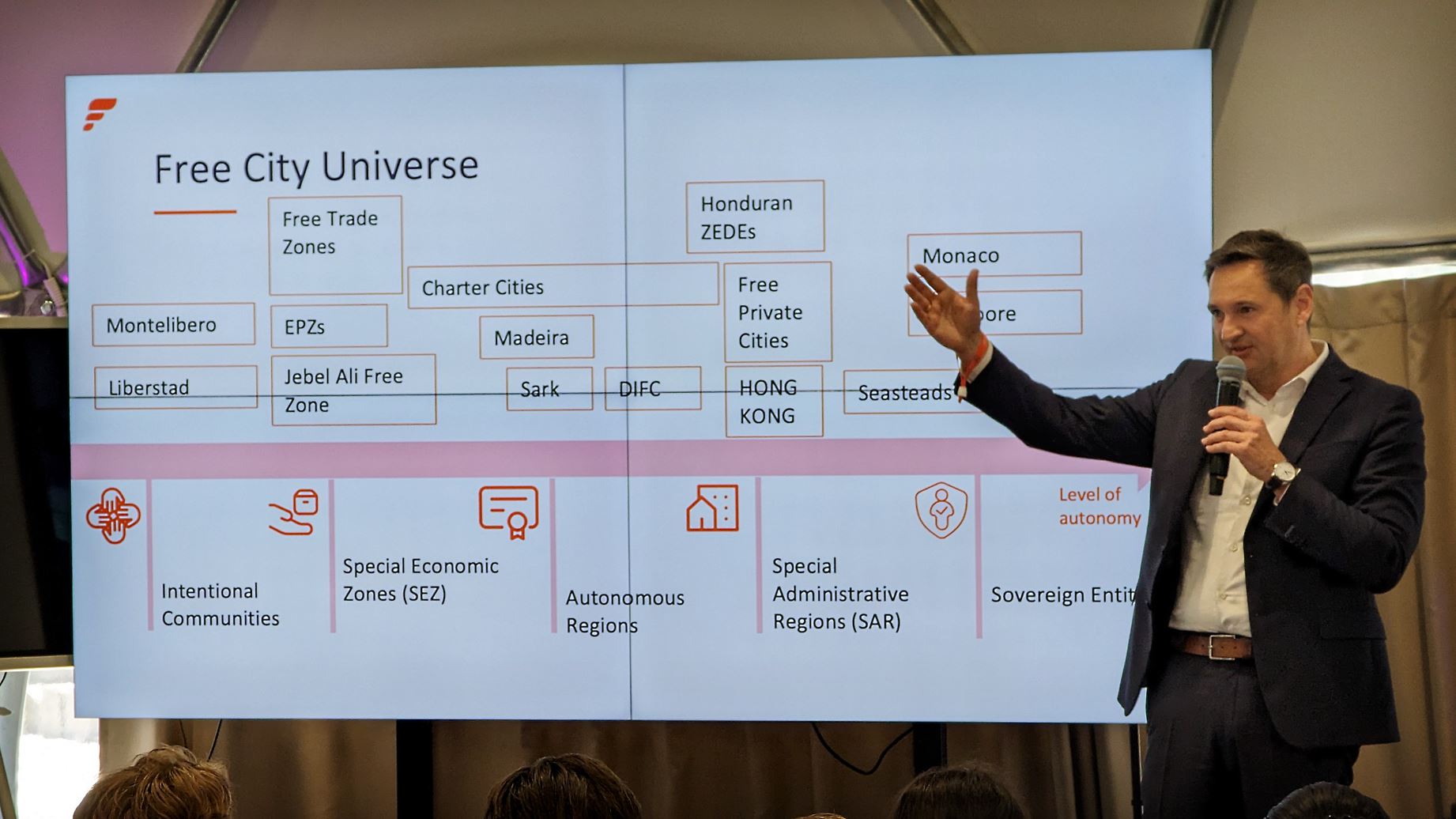
Just to make it clear, today we have real city-states like Monaco and Singapore, but we also have a lot of cities that are not really independent but have a kind of city-state character, like Hong Kong, which is under the sovereignty of China, and Dubai, which is under the high sovereignty of the United Arab Emirates.
In medieval times, it was a little bit like that. They were de facto independent, but not officially sovereign. So that means there was no president or something like that.
But coming back to your question, how was life? I can give you what I have got from all the books that I read when writing my own book about the medieval time.
There was a very important aspect. It is called, in German, Stadtluft macht frei, and that translates into "city air makes you free." It is a little bit strange. What does that mean?
It means that when you were living in rural areas, in some areas you were basically owned by your ruler. You had to do some work once a week and stuff like that. To escape that, I do not know the English technical term for that, but it was a kind of serfdom. If you managed to escape and were not called again for one year and one day, then you were considered a free man.
So what happened is that people ran away from their rulers and hid in the cities and did not leave the city for a year and a day, thereby becoming free. That is the reason. Of course, it is not the air of the city that makes you free, but this saying still exists in the German language, though few people understand what it means.
Also, if people want to describe a long period, they say, "after year and day," and people do not understand why they say it.
Timothy Allen: I think in English we say "a year and a day" as well.
Titus Gebel: Probably it was also popular in Europe. This is a kind of term where people say, okay, this is one of our rules: you can go after your serfs, but not after a year and a day, because there has to be an end to that. It is a little bit like if you commit a small crime and, after three or five years, it is basically null and void.
Timothy Allen: I still want a bit of a description, but I have some questions I can go on with. I had a couple of thoughts when you were speaking there.
Number one is, in the time of the Free Imperial Cities, if the central government, or whoever it was, the emperor, had no standing army and no… what were you getting from this central body? What was the benefit? How did the Free Imperial City benefit from this relationship?
Titus Gebel: It did not. The point was, the empire was first. It was the Holy Roman Empire. Of course, it was basically the Germanic barbarians taking over Rome and then declaring themselves the successors and calling themselves the Holy Roman Empire. Only later did they add, "of the German Nation."
It is a kind of idea that the emperor was always normally fighting with the pope, but the pope was the one who crowned the emperor, and the emperor said he was sent from God. People believed that.
Over time, the more powerful local dukes, grand dukes, monarchs, or even kings wanted to have a say. They wanted to have a say in who became the emperor, which was normally one of them. Among the monarchs in the Holy Roman Empire there was also a two-class society. You had the monarchs who were entitled to elect the emperor, and the others. But even the others had their own principalities or whatever. Basically, they were the rulers.
The whole emperor thing was only: okay, we are more powerful and we can assemble a bigger army if we stick together under the leadership of the emperor. It was like you see in the movies, where the emperor is asking, "Who is giving me soldiers? How many?" Like in Game of Thrones. That was reality in medieval Europe. The emperor was begging for money and soldiers to wage war.
Timothy Allen: Did they pay tax, or tithes, or whatever?
Titus Gebel: No. The Free Imperial Cities were really independent, basically. After hundreds of years of fighting, they had basically the same status as a monarch or as a prince. They were directly under the emperor.
There was one thing. Because there was no capital in the Holy Roman Empire, if the emperor was travelling around, which he was all the time, and he hit some fixed points, like Aachen, then there was an obligation of all princes, all cities, everyone, to feed him and his people. That was unwanted because it cost money, but nobody doubted that obligation because he had no capital.
It is an interesting concept. That concept, by the way, which is very decentralised, with no strong central power, lasted for one thousand years. That is definitely something where you can say, okay, something lasted for one thousand years, there must have been something right.
Timothy Allen: Yes, it must have done something right.
As a side question, are there still families that originated from these cities that are powerful families now? I take it the cities were run… no, maybe I should ask that question first. Who ran the cities?
Titus Gebel: The business people and traders. I looked up how this started in Cologne. Cologne was one of the biggest cities in medieval times. It dated back to Roman times. It was a city founded by the Romans. After the Roman Empire collapsed, it survived, and then after the Dark Ages it still flourished a bit.
It was part of the Archbishop of Cologne's region, and the bishops at that time were like princes. They had an army. They were basically the leader.
Around the year 1074, there was a first known uprising or riot in Cologne because the merchants of Cologne were treated badly by the archbishop and in an unjust way. It is not fully clear what happened, but that is in the books. There was really an uprising in the city, and the archbishop used brute military force to suppress this upheaval.
The next thing we know from Cologne dates forty or fifty years after that. Somehow they managed finally to get their own court for the city, which was independent from the archbishop. That is always something which is very important, and at that time it was especially important for the merchants, who were the driving force behind all these city projects.
They did not want to be subject to these religious judgments, trial by fire, and these really strange esoteric or mythical things. They were business people. There was a civil law issue, and this was a big point in many cities: they wanted commercial courts, not these religious courts with strange mechanisms.
They got it, somewhat against the will of the archbishop. He had to make some concessions. Another fifty years later, we hear that they finally established the city council, against the will of the archbishop, where they could at least make some decisions.
Over this time, one hundred and fifty years, they were permanently trying to regulate their own affairs in a way that better fitted their needs. Again, the driving forces behind all that were the merchants.
The cities were marketplaces. The market is not like today, where we say there is a market in Cologne and mean a place called the market. Markets at that time were only happening from time to time. The city says, "We are entertaining a market," and the market was going on for two or three weeks. Then merchants from all over the region were coming. Word spread around that there was a market in Cologne, so everybody was coming.
There were special market rules necessary because people were coming from other principalities, lands, and countries. Normally, even the monarchs, like the archbishop, gave guarantees saying, "If there is a market, we will protect you." At the beginning of the market, there was a special court elected out of the merchants participating in the market for all the commercial disputes that might arise during that time.
Other monarchs gave guarantees that if somebody was robbed during the market, they would pay him damages, to get people gathering there. That perpetuated in the bigger cities like Cologne over time, so there were standing courts accepted by the archbishop.
The merchants said, "We want different rules from the rest of you." It was a kind of special economic zone, version 1.0. We need commercial rules that differ from the normal rules.
Eventually, the merchants in the cities became powerful because cities are denser and have more productivity because more people are exchanging and there is infrastructure there. They became so powerful that they said, "By the way, we do not need the principality at all. We have a permanent market and we want to live according to our rules that are best for us."
Still, ninety percent of the population had nothing to do with those rules and the leadership of the city.
In the case of Cologne, after one hundred and fifty years after the first uprising, there was an independent city council that could make some decisions, but it was still under the sovereignty of the archbishop, which was still unwanted. Then, fifty years later again, with the help of a neighbouring prince, they beat the archbishop on the military field and kicked him out of the city. That was in the year 1288, and since then Cologne was governing itself.
Of course, it lost that again when the German Empire, the Second German Empire, was established in 1871. But it is a long time. It took them two hundred years, and they were one of the first cities to do that because they were one of the first existing cities in the borders of today's Germany.
It took them two hundred years to get rid of this leadership and become independent. Then other cities followed. It happened much more quickly for later cities. More cities came into existence over those years in the Early Middle Ages, and they all copied that: get rid of your prince.
Interestingly, I do not know exactly when, but the heyday was around 1300 or 1400. Then that flipped around, and suddenly the monarchs recognised that it was good to have a powerful city because of the economic effects that lifted up the surrounding land. Then they started to offer people land to found new cities and guarantee that they were independent and only under the leadership of the emperor.
This is an interesting development. Then you had this Cambrian explosion of independent cities, with several hundred in Central Europe.
Timothy Allen: The question about the markets: are you talking about a market for commodities, or a market in the sense that we think of a market, a massive area where people are selling everything?
Titus Gebel: They were selling everything. There were two types of markets. One was people selling everything, like today. They were selling fruits, all kinds of clothes, everything.
The other type of market was a specialised market. In the city where I come from, a small city, which was also independent, but had maybe only one thousand inhabitants at that time, they had a Bohrermarkt. A Bohrer is like a drill, a drilling tool. This is still celebrated today. The market has long disappeared, but the name has remained. Now it is more an entertainment thing for a week.
But that gives you the impression of how it worked. It was once a year, for one week, and only for one product. Everybody who was producing borers or drills knew that in the city of Neckargemünd, in that case, they were coming together once a year. If you needed something like that, you had to wait until the next market happened.
In other cities, like Cologne, I think there was a market where everything was sold. Then of course you had horse markets and cattle markets and all kinds of things. But I was surprised that such a secondary device as a drill had its own market.
Timothy Allen: There were not as many products back then, were there?
Titus Gebel: Yes, but it is interesting that there were markets. There must have been demand for such things. This is basically, I would say, rather business-to-business.
People underestimate how much economic activity happened in the Middle Ages. We have this idea that the Roman Empire went down, and there were just Dark Ages until the invention of the steam engine. That is not true.
People invented a lot of stuff in the Middle Ages. They created a bank account system in Northern Italy. They came up with tremendous inventions in the mining sector in Germany, and in smelters and all that. For example, Martin Luther's father was a quite successful smelting master for copper. He knew how to separate copper from the rock by melting it. He was a smelter and got some wealth out of that, and he could finance Martin Luther's theological university studies.
That gives you some hints about what the economy was at that time. It is not that they were all just praying all day long and working on the field to make some grains. There was an industry for the mining sector and metal-making already, which you can really call an industry.
There is only one guy called Agricola, who was a doctor. His real name was Bauer, which means farmer, but the Latin version sounds more noble, so he called himself Agricola. He wrote a book about all the inventions in the mining sector, and without him we would not know that, because these people were not appearing in the history books. It was profane commerce.
Our historians are also people who have not enough contact with the real world and the real markets. For me, these people are heroes. They developed, out of wood, large mills. If you tread them, you can get water out of the mines. There are other things where you say, this is tremendous. Or the cranes they developed to unload ships. It is totally unknown who invented them, and they were not praised at that time either.
If you were a priest, a king, a prince, or nobility, and had nothing to do with this profane money-making business, that was over all the Middle Ages. If you were designing an altar for a church, your name was known. If you were inventing a new machine that enabled people to increase the output of copper mines so that everybody would have more metal pieces and the whole standard of living was raised, nobody even wanted to know your name.
That was true over hundreds and hundreds of years. In reality, the merchants became more powerful because they were producing something that people were looking for. Especially with trade, the problem was that you had too many different rules and too many different tolls. The merchants said, "If we really want to make business, we have to have special rules." That was accepted.
They got their special market rules, and over time that fortified into an alliance called the Hanseatic League. Again, it was the merchants saying, "We want to have these rules, and we want to have them in other cities as well."
Timothy Allen: Did that include weights and measures as well? They were all different, were they not?
Titus Gebel: They were all different, and they still remained different. The Hanseatic League did not create one system of weights and measures. That is a good question. I do not know exactly, but I think I would know if they did.
When the Second German Empire was established in 1871, it took another ten years to harmonise all these different weights and measures. Obviously there was not something like that before. But probably the Hanseatic people had agreed on something, or they knew, like we know the dollar-euro exchange rate, what the rates were in their minds.
Timothy Allen: Are you saying there were not many markets for your average citizen to trade fresh fruit, veg, and that kind of stuff? Or were they in existence as well?
Titus Gebel: I think this was the way to deal in the Middle Ages. You just opened either your shop, or sold what you harvested from the field. The bigger markets were for more elevated products, like clothes, or not machines exactly, but metal tools and things like that. But I think in cities, for food, there was a daily market like today.
Timothy Allen: That is what I thought.
Using Cologne as an example is quite good. Did Cologne, when it was a Free Imperial City, have a wall all the way around it, and entry and exit points?
Titus Gebel: Absolutely. I would say every city that was not totally small had a wall around it. This is another thing. If you have a powerless, or limited-power, emperor, there are regional wars going on all the time.
The advantage of having city walls is that before you had a wall, there were armies of principalities, hired mercenaries or whatever. Often the prince could not pay the mercenaries and then told them, "Just loot the city. Instead of me paying you, you can keep what you get there."
The cities wanted to protect themselves against that, because that is also a human constant. If you are rich and the neighbours are not, then they might get the idea to take it away from you. It is still so today that rich city-states like Monaco and Singapore put particular effort into security.
Cologne, like all the cities, had a big wall. In the absence of a standing army, there was an obligation for the people in the city to defend the city. They had clear rules. If you were living in a certain quarter, you knew this was the part of the wall where you had to go in case of an attack. Then the bells were rung in the churches, and you knew something was happening. The doors were closed, and they were all manning the walls. This was pre-organised.
The advantage of that is that you did not have to pay for a standing army. Maybe there was a small force standing, but in war the idea was simple: we have big walls and enough food reserves for a year or two. That was a big advantage for the defender. From a technological standpoint, that made cities able to remain independent because it was easier to defend than to attack.
That remained so for a very long time. It is always the case that if you have military technology that enables the attacker to be stronger, like later guns, although the first guns were not really effective against metre-thick walls, then things change. Later, when guns became better and better, the medieval wall was not protection enough anymore, and then these cities disappeared or became part of the principalities or countries again.
Timothy Allen: Did they have any way of knowing who was coming in and out?
Titus Gebel: I think certainly they had special gates or ports. You notice this because today these names are still there. Normally, a city did not have only one gate, like a castle. They had one in each direction. Bigger cities like Cologne probably had eight entry points, and every entry point had a guard.
I do not know exactly how they did it, but I know that many cities did not want poor people to be in the city, even not as workers. They were allowed to work, but they had to leave the city again.
Other people who wanted to settle permanently in the city, they were competing for those people, because in the Middle Ages, especially after the plague killed one third of the population, they were all competing for qualified, skilled people. They were offering all kinds of things, but unqualified people were not wanted.
They were tolerated, and you could come and maybe hide because there was no digital surveillance. If you were in the city and hid, then probably you could be there. But they said, okay, you can become a member of the city, but you have to pay something as an entry fee because we built all the walls and everything. So people had to pay if they wanted to become permanent residents or citizens of Cologne, for example.
If there were people coming in with wagons and things to sell, that was not a problem for the guards. It was beggars who would be refused at the gates.
Timothy Allen: What about buying property, then? Say someone decided, "Right, Cologne is my city." You get to the front gate. The guard says, "What is your business?" You say, "I want to come and live here." What do they do? Who do they go to?
Titus Gebel: I think the city council would make the rules. They would say, okay, we are in need of people or we want to grow, so let us attract population. They would send people out shouting, "The city of Cologne is looking for new residents," with a drum.
Timothy Allen: Like you see in the movies.
Titus Gebel: Yes. But there certainly were procedures for how to approach it, and the city council was the decisive body. They would say, okay, if you want to become a member of our city, then you have to tell us your profession. We may not need some professions, which is still the case today in Monaco, for example. They ask you, "What is your profession? How do you make a living?" If you say, "I want to be a lawyer or a real-estate broker," they say, "No, we have enough. You cannot do that." You have to come with something else.
Probably that was the same there. Then they said, okay, you have to pay something as an entry fee, or if we are in urgent need of people like you, we skip that entry fee.
Normally, how did they make money? You had to pay a toll if you were importing or exporting things or selling things. Sometimes, if there were transactions, if you applied to buy a house or whatever, you would have to pay something. But this differed from city to city.
Timothy Allen: So private property rights were similar to what we see now? Some people were landlords, some people owned property?
Titus Gebel: Yes, there was a market. More cities were ruled by the elites, of course, who were merchants and property owners.
Over time, the same happened as with the emperor. The smaller monarchs wanted to have a say over who became emperor, and the same happened in the cities. The number of people who wanted to decide about the city council also increased. We have seen this before in ancient Greek city-states. The downside to that is that they came up with all kinds of taxes and all kinds of redistribution things. You had to be careful if you were a wealthy person in some cities that they would not just come up with some ridiculous claim and seize your property.
These were the downsides of an ever-increasing electorate. But for hundreds of years, in the German cities, it was really the merchants. Not so much families as in Italian cities, where you have the famous Medici family running Florence for hundreds of years.
Again, if you have several hundred cities, you do not have one system for governing the city. But in principle, this democratic idea that there is a city council, which is elected, and the city council then elects or nominates a mayor or something like that, is the standard model until today.
Timothy Allen: Another question about the physical structure of these cities. Was there land available in these cities, or were they pretty built up? Was the wall enclosing just buildings?
Titus Gebel: If you look at the old towns that we have today, they are extremely dense. That is because the room was limited after the wall was built. There were no parks or stuff like that. Of course, there were cities which had land and were growing and then building the wall.
But for most of the medieval period, I think you had only the choice between buying an apartment or a small or expensive house in the city, or buying a house, tearing it down, and building a bigger house in the city at a high price. Or you could go outside the gates and build something there. This problem was only overcome, I think, in the eighteenth century, when they were tearing down the city walls in order to grow.
Timothy Allen: How does the City of London fit into this? Bishopsgate, Aldgate…
Titus Gebel: Exactly the same. This is a development that you have seen all over the place.
An interesting thing about the City of London is that the Hanseatic League even had a warehouse there. In this warehouse, the rules of the Hanseatic League, or whatever they agreed, were applicable, not the law of the City of London. So today, I would say it was a special economic zone for Hanseatic traders.
That was it. This is another misconception about the Middle Ages, that they were all totally isolated in their villages and behind their walls. No, they were trading with all the known world. That was other European cities, and depending where they were, the successful Italian cities of course had Mediterranean trade with the Ottoman Empire. Eventually Indian goods were coming, and things like that.
The Hanseatic League was a trade association first and foremost. They traded no matter what country, religion, or nationality.
Timothy Allen: They were all Christian, right?
Titus Gebel: They were different factions, but they did not care.
Timothy Allen: Interestingly, I worked in London for seven years as a journalist, and the City of London Corporation had its own police force. The old City of London, because we were forever coming into contact with them. They were a different breed. That is basically everything within the old city wall.
Titus Gebel: These are remnants from the old times, definitely. Bishopsgate alone shows you that there was more than one gate, otherwise there would not be a necessity to name it, and there was a wall. I think still until today they have some special rights. These were the original city rights from the City of London, which was a small area compared to today's London.
Timothy Allen: The guilds too. I went to a school owned by the Skinners' Company, the people who skinned animals. The Guildhall is where all the guilds of all the traders were.
Titus Gebel: This was also one of the downsides of the basically unlimited regulatory power of the city council: they came up with these guild ideas. Everybody who makes shoes must be in the same road. If your father is a shoemaker, you can become a shoemaker, but not a tailor. Today we say stupid stuff like that, but it was the reality for hundreds and hundreds of years.
On the other hand, people say, no, these guilds were there before. One of the reasons that people in these cities wanted to get rid of their princes and dukes was that they were regulating anything: how to dress, how much to eat for your wedding, how many meals a day you could have. They were really going deeply into your private life, as we would say today.
What you can see now in today's world are neo-feudalistic tendencies to regulate again what people eat, how they speak, and all this. This has all been there before. This was one of the reasons why the city people wanted to get rid of these stupid regulations and make their own stupid regulations instead.
Timothy Allen: Talk about the decline of the medieval city-states. What was the reason they declined, according to you?
Titus Gebel: The rise of the modern nation-state. Weaponry plays a role, then standing armies and better administration. Actually, it was Napoleon who was the deadly blow for most of the German cities, and also Italian cities, because the Holy Roman Empire ended in 1806, when Napoleon forced the last emperor, who was also the king of Austria-Hungary, to abdicate. A one-thousand-year history was coming to an end.
With it, many of the independent, de facto independent cities came to an end. Napoleon was basically just erasing it and saying, okay, we make a new map. There are too many different entities in the Holy Roman Empire. Out of two thousand, we make, say, one hundred and thirty. That means all the smaller cities were given to the princes. Only the bigger cities, like Frankfurt, Lübeck, Hamburg, and Bremen, remained independent entities within Napoleon's satellite state, and later within what was called the German Confederation, before the Second German Empire was established.
A lot of big cities came to an end at that time. Venice was also captured by Napoleon in 1797, came to an end, and never came back.
If you can mobilise large armies with modern weapons, have a standing army, and have standing taxation, then the advantage of the cities, that they can easily defend themselves, was lost. Their meaning was also lost because it was a powerful player, and people would say, "Maybe I would rather become part of this powerful emperor than this small city." The time was just over for them.
Timothy Allen: There must be some important lessons to be learned then. The current free cities model has much in common with the medieval cities model. What lessons can we learn from the demise of those states about how modern, contemporary free cities might work and might mitigate the same issues that caused them to fail?
Titus Gebel: I think one of the positive lessons we can take away from medieval city-states is that you should guarantee certain rights and establish rule of law and independent courts to give not only the merchants but all residents legal stability.
The other thing is: do not spend too much on defence, but be capable of defending yourself to a certain degree, or have allies that help you. Without any defence potential, it is probably difficult. But it is not necessary that you oblige all the citizens to defend the city. If you have the right to bear arms and allies, like the people of Cologne had an allied prince who helped them throw out the archbishop, that is very important. Diplomacy is very important.
The other thing is, do not spend too much money on the penal system. One of the main things they did was banish criminals. They would not feed them for thirty years in prison. If somebody stole from the people in the city and consumed it, the city people would say, "Okay, you have stolen this money from us and eaten it, and now we are paying another thirty years for you? You are crazy." But that is what we are doing today.
This is something where we can maybe learn from the city-states: if you misbehave, then you have to go. It is also positive selection and a deterrent for other people to behave well.
The downside where we should be careful is establishing a council that has unlimited powers to regulate. That does not end well. So far, we should really limit the administration, the governance of the city, to the basic stuff: protection of life, liberty, and property, providing some infrastructure, and having independent dispute-resolution systems. But do not interfere in the private sphere and life of the people.
How can we cope with what brought all these cities to fall, which is big empires and big nation-states? The only answer I have is alliances with other cities, with friendly governments, and creating a certain deterrent.
On the other hand, cities like Venice, a single city, in the sixteenth century had the most powerful fleet, both naval and trading fleet, in the world. A city that has a lot of economic potential will eventually also have some military potential.
The interesting thing about what we can learn from Venice is that, with diplomacy and by not interfering in political and religious conflicts that their neighbours were fighting, Venice survived for eleven hundred years without a single government being overthrown.
One of their leading figures at that time said: we had powerful enemies, the pope, the Habsburg Empire, Austria, France, the Ottoman Empire, whatever you name it, and we never lost the life of one of our fellow citizens. Why? Because we paid money for mercenaries from other countries.
This is something I see coming. If you look at today's world, nation-states are more and more reluctant to sacrifice the lives of their own people, so they are hiring mercenary groups like Wagner or Blackwater. This is something where we will probably see some revival of things that existed in the past, and hopefully also independent cities.
Timothy Allen: Unfortunately, the hiring of mercenaries in the future might be robots or droids.
Titus Gebel: The ultimate mercenary would be something like that.
Timothy Allen: Almost certainly. As you were speaking, I was thinking about the overthrow of the old city-states. It was the might of the larger state coming in. In another hundred years, who knows what that might looks like? Who knows what kind of political battles are going to be fought and how they are going to be fought?
We are already reaching the point where the arms race is becoming a bit futile because no one wants to use any of these arms anymore. It is not like cannons and muskets. You can destroy everything now.
Titus Gebel: We have wars. They are not using nukes, but they still make war. Russia has attacked Ukraine, and is not using nukes, and probably will not do it, but there is still potential for war in a conventional way. This will probably not go away so quickly.
But I think you are right in principle. There is a tendency not to make big wars because they are very expensive, and reputationally it is not good. In today's world, you cannot just tell people, "We are the good and they are the bad," and many people do not buy it.
You have many people in Russia fleeing conscription. Even in Ukraine, people do not want to fight for their government or their political ideas.
I think the tendency we had in the Middle Ages, in cities, or even free villages that were directly under the emperor in Franconia near Schweinfurt, is interesting. People like us want to be more independent and make our own decisions, a little bit like the people in the Middle Ages who did not want the archbishop to decide what was happening in the city. They wanted their own decision-making process.
Now it is one step further. I do not want the city council to tell me what to do. I want to make my own decisions, but I need somebody to protect me. Because of the division of labour, I could protect myself, but it does not make sense from an economic standpoint. If I hire somebody who is doing that, it is better.
So this is the next step. In a way, it is comparable to the Middle Ages. In a way, it is going further, saying we are creating entities that are based on being service providers for the needs of the people. No more need for majority decision, because this is also a dangerous thing. It can backfire so that they come up with all kinds of regulations that strangle you.
Then we have people who do not buy those collectivist things, like "we all have to stay together and fight against the other group." More and more people say, "I know history. Normally that is nothing we profit from."
That was even so before the Second World War. You might have heard that in the First World War, people were cheering and saying, "Hey, finally something is happening." Not so in the Second World War. They had that experience, and it was not very popular. Even in Nazi Germany they did not make too much fuss about it. They said, "We are just defending ourselves."
I think it was Hermann Göring, the Nazi number two after Hitler at that time, who said: what is the best outcome of a normal soldier all over the world? It is coming back without bad injuries. That is the best case. Therefore war is not popular, and therefore we have to make all kinds of propaganda around it.
I think there are enough people today who do not want that. Russia is a good example. You would have thought there was a lot of patriotism and nationalism in Russia. They have the media in their hand and can influence the people, saying, "We are not attacking Ukraine. We are defending ourselves against the West," or whatever. But still people do not want to be conscripted, and they were fleeing the country in big numbers.
I think the same would happen in China if people could escape. People do not want to die for other people's ideas.
I think it is a bit fleeting to a world where people want to choose under which regime they are living. That means, in my view, hopefully in one hundred years we will see a big variety of different entities that are states, semi-sovereign entities, or whatever, like in the Middle Ages, where in the Holy Roman Empire there were two thousand different forms of sovereign or semi-sovereign arrangements and all kinds of methods.
The good thing was that if you were dissatisfied, you just moved five kilometres away and then you had a better regime. The bad thing was you had to pay taxes, tolls, and duties each time you crossed a border. But we can cope with that. You can say it is a common trade zone, and then you do not have these duties.
All these criticisms against the small states of the Middle Ages, that they had different measures and you had to pay duties each time you crossed the border, we can cope with that. You can use the same measures. You can say we are not charging any duties. Then you have solved the problem, and suddenly the beautiful aspects of small states come into play.
Timothy Allen: Final question, then. Is there anything we can learn about the size of free cities from medieval cities?
Titus Gebel: There were no million-person cities in medieval times. Of course, there were fewer people on Earth, but I think it is important that a city does not exceed a certain size. If it does, it should basically create a new city.
In the medieval city, it is not that everybody knew everybody, but you knew your neighbours, and you knew your council members personally. You knew that your neighbour was standing beside you on the wall, and that one person in the block was the sergeant or whatever they called it.
This is a different situation than we have today. I do not think we can definitely come back to the same arrangement where everybody will defend the city and stuff, but in a way I was thinking about people who voluntarily support the firefighters, police, or defence forces. They could get a deduction from their annual fee, or things like that, which also creates a kind of community but does not force people to do something.
Timothy Allen: Thanks for that. That is fascinating. I feel a lot brighter and wiser than I did an hour ago.
I just thought of one other question. You just mentioned it. Did people pay a yearly fee to be a member of the city? Was that the case?
Titus Gebel: No. There was quite often a one-time fee for new entrants, because the others said, "We paid for all this construction and you did not, so you have to pay something."
Then they had taxes. It was a tax system. Mostly I heard that in cases of attack, where they needed more money, they put extra taxes on beverages, food, and stuff like that. But there was no income tax at the time. It was really more indirect taxes for transactions, like importing and exporting goods. Again, in wartime, you might have a beverage tax, which was then abandoned after the war.
Timothy Allen: No bonds and things like that issued? The Venetians, or the Italian ones, started all the central banks, did they not?
Titus Gebel: They started banks at all. They also had a debt system. In Germany, it was Fugger in Augsburg. It was a tremendously successful, powerful, and mighty bank. He could decide who became emperor. So mighty was he.
The Italians were the first who came up with printed paper bills as a kind of IOU. That happened there.
Timothy Allen: Did that make them more powerful? They were some of the more powerful cities.
Titus Gebel: I think if you have a banking system at all, that enables you to pay in here and pay out in another city that is far superior to putting all kinds of coins in a wagon and trucking it to the other city. Definitely, the invention of the banking system made the upper Italian cities very powerful.
Timothy Allen: Great. Well, thanks, Titus. It is very informative. I think it is a great subject. It is a really interesting subject, something I had never thought about until I bumped into you guys. It is nice to see that there are at least a few historical examples that we can look back on, because at the moment, in the present, we do not have a huge amount to draw upon other than theory.
Titus Gebel: This is important. If you come up with a new idea that has never been tried and never been tested in what I call the market of living together, there is a high probability that it is not working, because otherwise it would have been there in one form or another.
What we try to do with the free cities, especially with the Free Private City model, is to say: okay, we have service providers. That is a known thing for thousands of years. We have had independent cities functioning according to a certain model, and they had to be, in a way, profitable, because there was nobody to lend money from other than their own people. They had to be at least neutral with their expenses, and they had to raise taxes in case of need.
So I think we can definitely learn from those examples.
Timothy Allen: Great. Well, thanks for talking. I will think of another subject for another time and we can do one of those. Titus Gebel, thank you very much.
Titus Gebel: You are welcome.